Hello Branch Families!
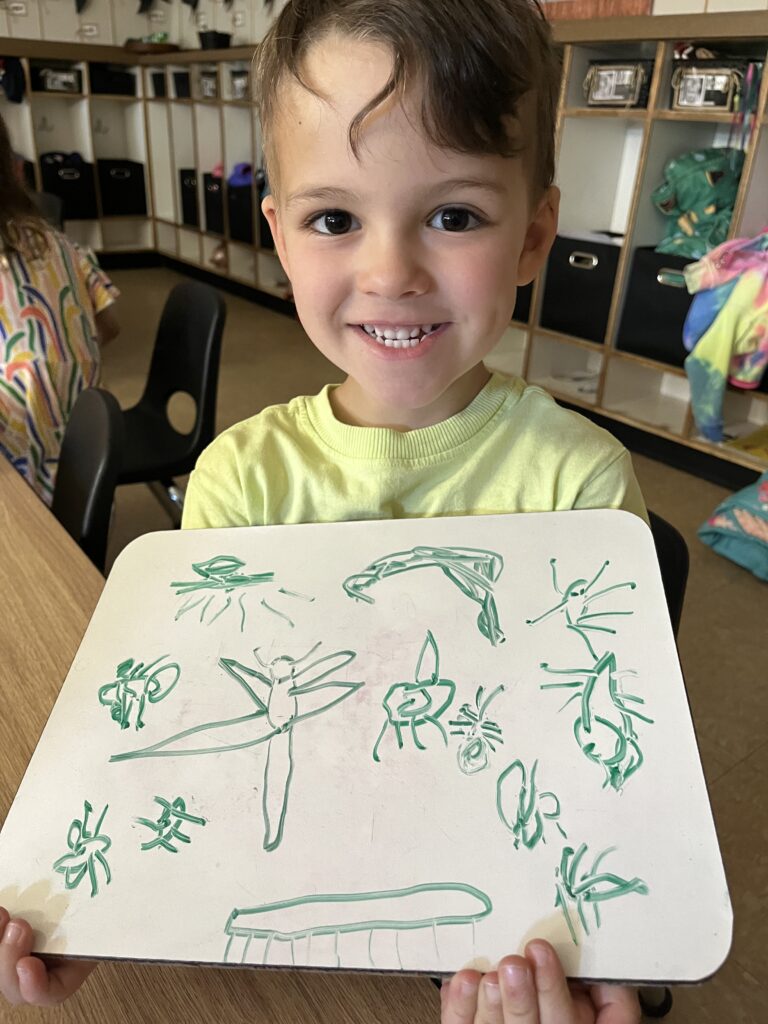
June has come and gone—just like that! Not only did we look forward to summer and the warm weather, but we also anticipated another fun month of learning, discovery, and exploration!
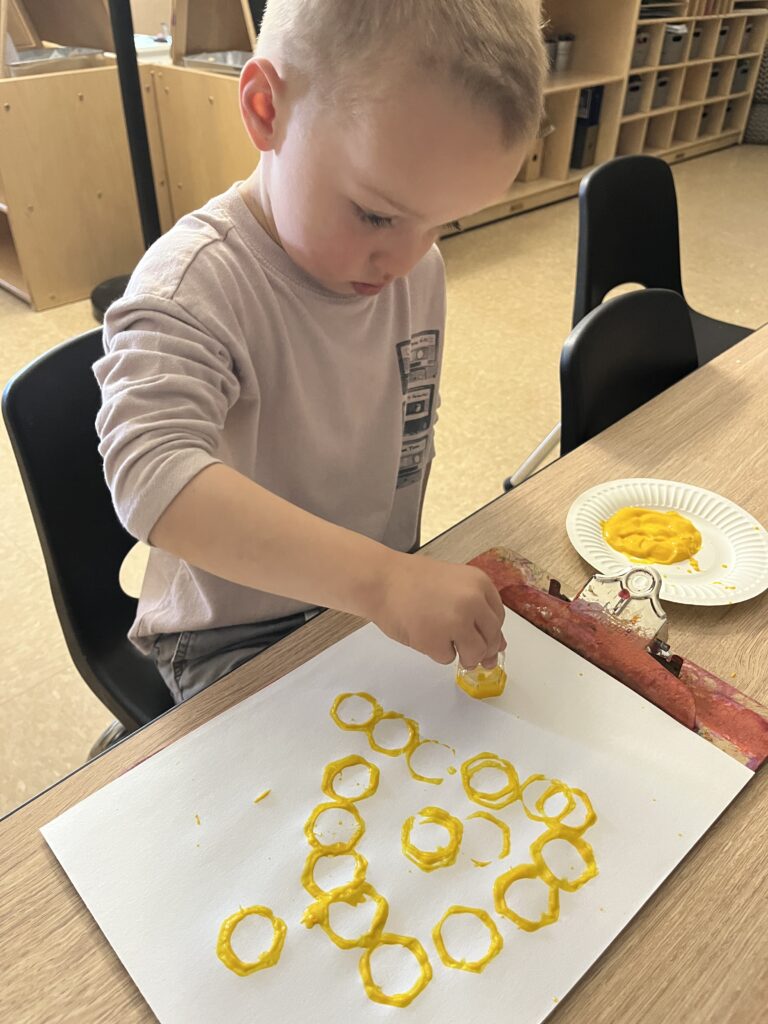
As we began our INSECT and ARACHNID unit, hardworking, busy, buzzy BEES were our first focus. We learned that bees know how to dance! When a bee finds a ‘sweet spot’ to gather nectar and pollen, it will put on its dancing shoes and ‘cut a rug’. As the forager bee dances, she directs the other forager bees where to go. Fascinating, to say the least! During our bee week, the Branchers made honeycomb self-portraits, bee name tags, and tested our taste buds with a honey taste test.
DRAGONFLIES and DAMSELFLIES, Oh My! It was incredible to see how quickly the Branchers understood the differences and similarities between these two insects! Although they look very similar, the Branchers found that there are three main differences in their eyes, wings, and body size. Soon, the Branchers were spotting these winged wonders and showing us examples of dragonflies and damselflies around the classroom and in the books available in the library. It was wonderful to see the children focus on the tiniest details that made them both similar and different.
Next in our insect adventure… LADYBUGS (also known as ladybird beetles)! During our outdoor exploration, we spotted ladybugs near the willow tree. Ladybugs are fascinating, mainly because of their unique life cycle. Luckily, we got to watch this lifecycle unfold right before our eyes! While exploring the playground, each Brancher used their search skills to find eggs, larvae, pupae, and even real ladybugs! To wrap up our ladybug investigation, we made paper chains. Using red and black strips of paper, each Brancher created a pattern of their choice. Many chose single-colored patterns (A, B), while others mixed it up with double-colored patterns (A, A, B, B). We enjoyed watching their pattern-making, fine motor, and scissor skills, too!
No insect unit would be complete without raising our own butterflies! Throughout the month, we watched the changes our ten caterpillars went through as they ate and ate, molted and molted (five times, to be exact) before turning into a chrysalis. Patience was needed as the ‘metamorphosis’ magic took place inside each chrysalis. When the wait was over, we had seven very healthy and beautiful Painted Lady Butterflies. The branchers looked on in wonder as they saw the butterflies’ wings wet and folded when they emerged from their empty cases. Gradually spreading and flapping their wings, each butterfly could pump blood through its veins into all four wings. Building wing strength made them hungry, so a treat was in order. Using its proboscis (straw-like mouthpart), each Painted Lady slurped up the sweet juice from a strawberry and honey water while the branchers watched in amazement. Soon, our butterflies were ready and able to spread their wings and take flight as we released them. Such a wonderful sight to see!
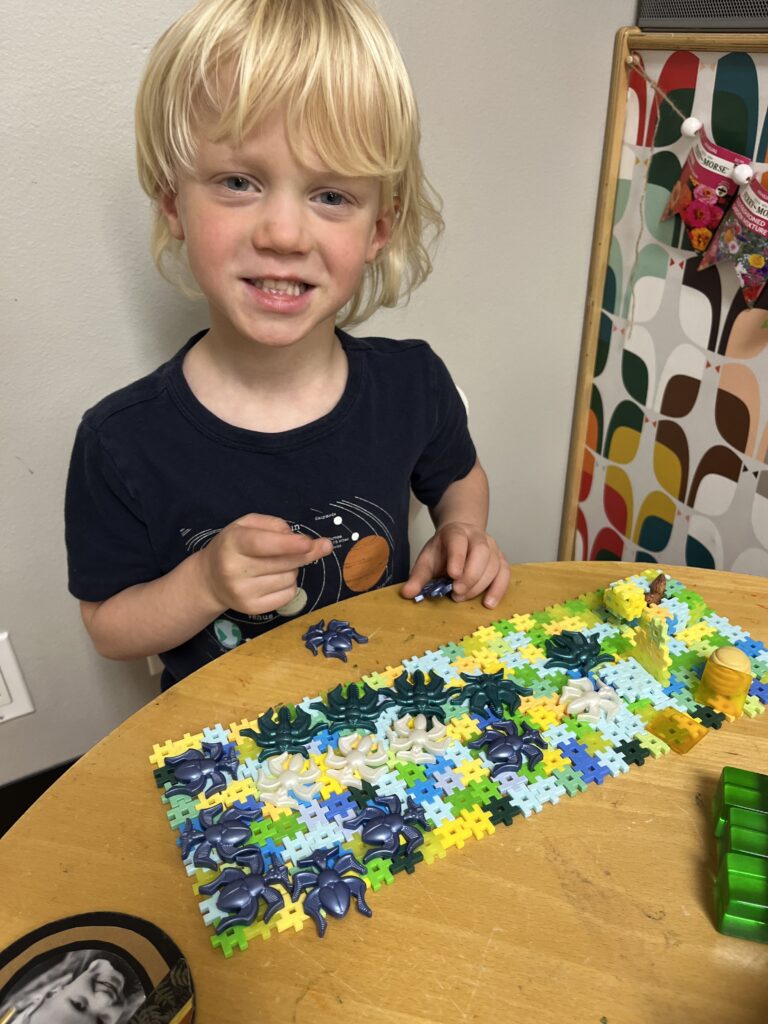
Next up…SPIDERS! A common misconception about spiders is that people often mistake them for insects. As the Branchers discovered, spiders are not insects; they are ARACHNIDS! We learned that insects have six legs and three body parts, whereas arachnids have eight legs and only two body parts. These distinctions classify them as different species. After discovering and discussing the spider’s characteristics, we learned some interesting facts, such as how spiders spin webs. We found that a spider has many uses for its ‘silk.’ Ask your Brancher if they can share how a spider can use their silk. Before moving on to the next insect, we had to create our arachnids! Fine motor skills were essential to generate each arachnid leg. With no surprise, the Branchers proved they were up for the challenge as they ‘accordion-folded’ each strip of brown paper. Eight accordion legs and eight googly eyes completed the silk-spinning spinneret headbands!
Next, we explored underground to discover amazing worms! We learned that worms aren’t insects because they don’t have six legs. Instead, they move using tiny hairs on their bodies. We also found out that earthworms have five hearts! After gathering information about worms, we got hands-on by introducing real worms for the Branchers to hold and measure at the sensory table. No lesson is complete without science! After learning so much about worms, we decided to talk about a tastier worm. With the help of gummy worms, we discovered that a gummy worm grows bigger when soaked in water! The most exciting science experiments involved tasting, so each Brancher tried one gummy worm. Studying science has always been a favorite activity in the branch room!
Wow; What a month! Watching the Branchers absorb and retain so much new information about this unit has been so much fun! However, the best is yet to come as we explore SPACE and the PLANETS. July is sure to be ‘out of this world’!
-Ms. Heather & Ms. Gracen
.